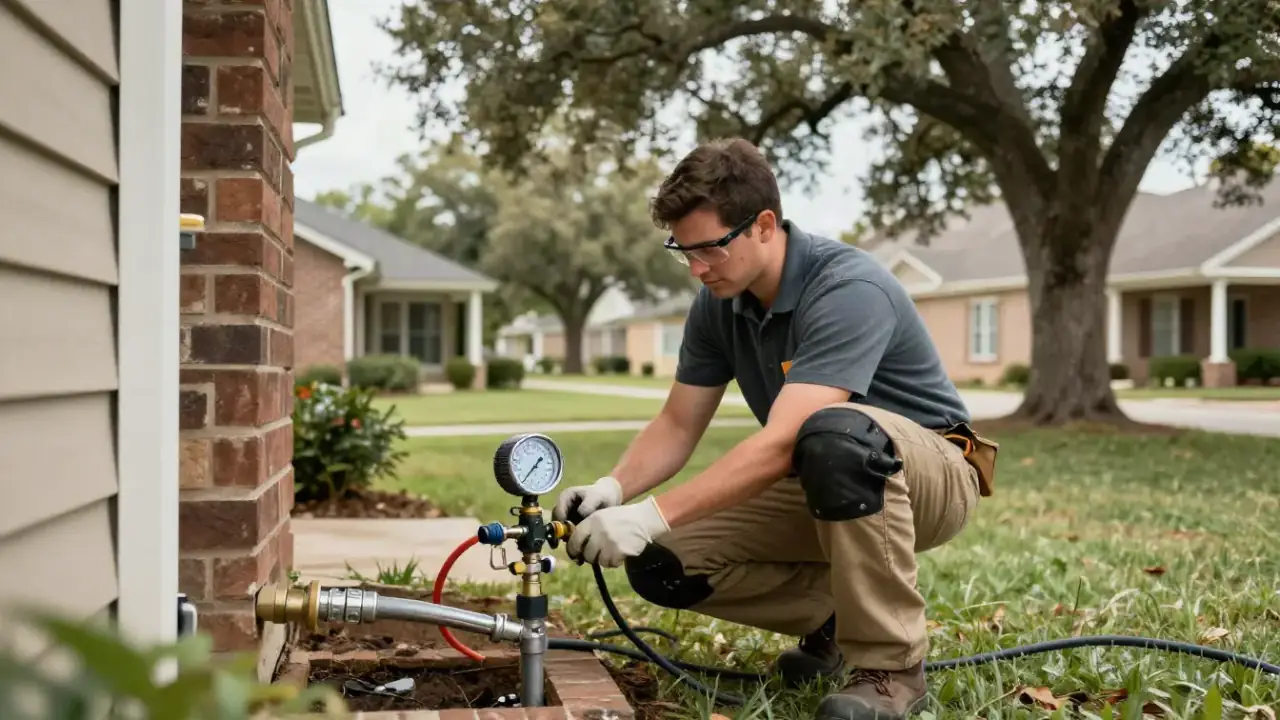
How Pressure Testing Finds Leaks Inside Walls
Pressure testing for wall leaks Spring TX pinpoints hidden leaks without tearing out drywall. Here is how the test works, what it costs, and when to call us.
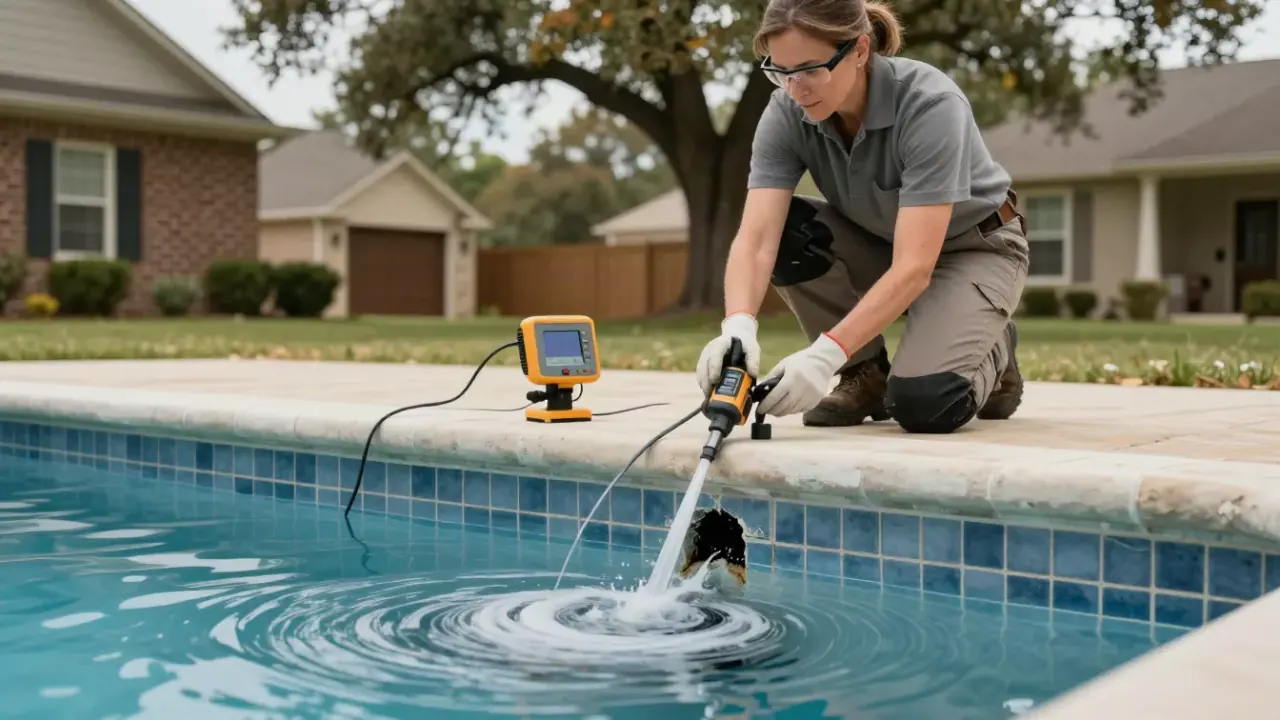
Pressure testing finds leaks inside walls by isolating a section of plumbing, filling it with air or water at a controlled pressure, and watching whether that pressure holds. If the gauge drops, the line is losing pressure somewhere in that wall cavity - and we can pinpoint the exact spot without tearing out drywall to hunt for it. In Spring, Texas, where slab-on-grade homes and 1980s copper supply lines are common, this test is often the fastest way to stop a slow leak before it rots framing or warps baseboards. Below, we walk through how the test works, what it costs in 2026, and when it makes sense to call us instead of guessing.
What Pressure Testing for Wall Leaks in Spring TX Actually Measures
Pressure testing for wall leaks Spring TX is a diagnostic procedure that pressurizes a closed plumbing segment and measures whether that segment holds steady pressure over a set time window. It does not measure water volume or flow - it measures loss. A healthy line holds its pressure; a leaking line bleeds it off.
Think of it like a bicycle tire. Inflate it to 60 psi and check the gauge an hour later. If it still reads 60, the tube is sound. If it reads 42, air is escaping somewhere. Your walls work the same way, except the stakes are higher: a pinhole leak in a copper supply line can spray a fine mist inside a wall cavity for months before you ever see a wet spot on the drywall.
We use two pressure ranges depending on the line. Potable supply lines get tested at 80-100 psi, which is roughly 1.5 times normal household operating pressure. Drain and waste lines get a different test - either a water column or a low-pressure air test at 5 psi - because they are not designed to hold pressure at all.
One number worth knowing: a single pinhole leak the diameter of a pencil tip can release 2-5 gallons per hour. That is 1,400 to 3,600 gallons a month, which is exactly the kind of spike that shows up on a High Water Bill Investigation Spring TX before any visible damage appears.
How Does Pressure Testing Find Leaks in Walls in Spring TX?
Pressure testing finds leaks in walls in Spring TX by comparing pressure loss across isolated segments - the test tells you which wall cavity is losing pressure, and acoustic or thermal tools then tell you exactly where inside that cavity the leak sits. The pressure test narrows the search area from "somewhere in the house" to "this six-foot section of wall."
Here is the logic. A home has dozens of supply and drain lines running through walls. Testing the whole system at once tells you almost nothing - too many variables. So we isolate. We close valves, cap fixtures, and test one branch at a time. When a branch loses pressure, we know the leak is in that branch. When it holds, we move on.
From there, we switch to listening. A leaking line makes noise. At 80 psi, water escaping a pinhole produces a high-frequency hiss that an acoustic microphone picks up through drywall, tile, and even brick veneer. We sweep the wall in a grid pattern and mark the loudest point. That mark is where we open the wall - usually a 6-inch by 6-inch cut, not a four-foot demolition.
Thermal imaging backs up the acoustic reading. A leaking hot-water line leaves a warm streak on the wall surface; a leaking cold line leaves a cool one. When the acoustic hot spot and the thermal anomaly line up, we are confident enough to cut.
For homes with copper supply lines under a slab - common in Spring neighborhoods built between 1975 and 1995 - the same pressure test logic applies, but the leak is below the floor rather than inside a wall. That is a different repair, and we handle it through Slab Leak Repair Spring TX.
The Step-by-Step Process We Run on Every Wall Leak
Every wall leak we test follows the same six steps. The whole process takes 90 minutes to 3 hours for a typical single-family home, depending on how many branches we need to isolate.
- Shut off and drain. We close the main shutoff, open the lowest fixture in the house, and drain the supply lines. You cannot pressure test a line full of water.
- Isolate the suspect branch. We close the angle stops at every fixture on that branch and cap the open ends. This creates a sealed segment.
- Pressurize. We connect a hand pump or regulated air compressor to the test port and bring the segment to 80-100 psi. For drain lines, we use a 10-foot water column instead.
- Watch the gauge. We hold the pressure for 15-30 minutes. A drop of more than 2 psi over 15 minutes means a leak. A drop of 10 psi or more means a significant one.
- Locate with acoustics and thermal. Once we know the branch is leaking, we sweep the wall with a listening disc and thermal camera to pinpoint the spot.
- Confirm and repair. We open a small access hole, verify the leak visually, and repair the line. After repair, we re-pressurize the segment to confirm it holds before closing the wall.
Step six matters. We never close a wall on a repair we have not re-tested. If the gauge holds for 30 minutes after the fix, the line is sound.
For homes on pier-and-beam foundations - a smaller share of Spring, but still present near Leak Detection in Old Town Spring - the same test runs, but the repair happens from underneath the house rather than through the wall. That is Under-House Leak Repair Spring TX, and it is often cheaper because there is no drywall to patch.
Is Pressure Testing Safe for My Plumbing in Spring, Texas?
Pressure testing is safe for plumbing in Spring, Texas when the test pressure is matched to the pipe material and the system is not already weakened by corrosion. The risk is not the test itself - it is testing an old, brittle line at the wrong pressure.
Here is what we check before we pressurize anything:
- Pipe material. Copper, PEX, CPVC, and galvanized steel all have different safe test pressures. PEX and CPVC handle 100 psi fine. Old galvanized steel that is already rusted from the inside may not.
- Age and condition. If we see heavy external corrosion or prior repairs with mixed materials, we drop the test pressure to 50-60 psi and extend the hold time.
- Fixture ratings. Toilets, water heaters, and ice makers have their own pressure limits. We isolate them out of the test segment so we are not stressing a $1,200 appliance to find a $40 leak.
- Water heater isolation. The tank and T&P valve come out of the loop. Always.
The honest answer: a properly isolated pressure test at 80 psi will not damage sound plumbing. If a line fails at 80 psi, it was already compromised and would have failed on its own within months - usually at 2 a.m. on a Saturday. Finding it on your schedule beats finding it on the ceiling.
How Much Does Pressure Testing Cost in Spring TX?
Pressure testing for wall leaks in Spring TX runs $250 to $600 for a residential diagnostic in 2026, depending on how many branches we isolate and whether we need to cut an access hole. A single-branch test on an accessible wall is at the low end. A whole-house isolation with multiple suspect branches and a drain-line test is at the high end.
Here is how the pricing breaks down:
- Single-branch supply test: $250-$350. One isolated segment, acoustic sweep, thermal scan.
- Multi-branch or whole-house test: $400-$600. Two or more segments, plus drain-line testing if needed.
- Access hole and visual confirmation: $75-$150 per opening. We keep these small - usually 6x6 inches.
- Repair itself: quoted separately once we know what we are fixing. A copper coupling repair runs $200-$450. A full branch replacement runs $600-$1,200.
We quote the diagnostic upfront before we start. If the test shows the leak is actually in the slab, the meter, or the service line, we credit the diagnostic toward that repair. You are not paying twice to find the same leak.
One more number: most homeowners we test have already spent $150-$400 on a plumber who guessed, opened a wall in the wrong place, and found nothing. Pressure testing exists to stop that cycle.
Common Mistakes Homeowners Make With Wall Leaks
The most expensive mistake is opening the wall first and testing second. Here is what we see repeatedly, and how to avoid each one.
- Cutting drywall before isolating the branch. You end up with a hole in the wrong wall and a leak still running. Test first, cut second.
- Assuming a wet spot is directly above the leak. Water travels. It follows framing, insulation, and gravity. A stain on the ceiling often traces back to a wall leak 8-10 feet away.
- Testing at full household pressure. City water in Spring runs 60-80 psi at the meter. Testing at that pressure with fixtures connected can stress appliances. Isolate first.
- Ignoring the water meter. Before any wall test, shut off every fixture in the house and watch the meter's leak indicator dial. If it spins, you have a leak somewhere - and the meter tells you whether it is supply-side or drain-side. That is the first step of a Water Meter Leak Diagnosis Spring TX.
- Patching the drywall before the line is re-tested. We see this constantly. The wall gets closed, the leak was never confirmed fixed, and three weeks later the same stain returns.
- Using a stud finder as a leak detector. It does not work. Neither does a phone app. Pressure and acoustics work.
If you have already made one of these mistakes, it is not a disaster. We can still test the branch, find the leak, and repair it. The drywall patch just gets bigger.
When to Call a Professional
Call a professional when the water meter spins with every fixture off, when a ceiling or wall stain grows over a week, or when your water bill jumps more than 20% with no change in usage. Those three signs mean an active leak, and pressure testing is the fastest way to find it.
You can handle a dripping faucet or a running toilet yourself. You cannot safely pressure test a wall without a gauge, a pump, and the experience to know what pressure a 40-year-old copper line will tolerate. Guessing wrong turns a $300 diagnostic into a $3,000 repipe.
Our team runs pressure tests daily across Spring, The Woodlands, Klein, and the surrounding areas. We isolate the branch, test it, locate the leak, and repair it - usually in a single visit. If the leak turns out to be in a commercial building rather than a home, we handle that too through Commercial Plumbing Leak Location Spring TX.
If you are not sure whether you need a test at all, call us and describe what you are seeing. We will tell you honestly whether it sounds like a wall leak, a slab leak, or something simpler.
Frequently Asked Questions
How does pressure testing find leaks in walls in Spring TX?
We isolate a section of plumbing, pressurize it to 80-100 psi, and watch the gauge for 15-30 minutes. A drop of more than 2 psi means a leak in that segment. Acoustic and thermal tools then pinpoint the exact spot inside the wall.
Is pressure testing safe for my plumbing in Spring, Texas?
Yes, when test pressure matches the pipe material and appliances are isolated. We test copper and PEX at 80-100 psi, drop to 50-60 psi for older galvanized lines, and always remove the water heater from the test loop. Sound plumbing handles it fine.
How much does pressure testing cost in Spring TX?
Residential pressure testing runs $250-$600 in 2026, depending on how many branches we isolate. Single-branch tests are at the low end; whole-house isolation with drain-line testing is at the high end. We quote upfront and credit the diagnostic toward the repair.
Can pressure testing find hidden wall leaks in Spring TX?
Yes. That is exactly what it is for. A pinhole leak releasing 2-5 gallons per hour inside a wall cavity produces a pressure drop and an acoustic signature long before it produces a visible stain. We find it at that stage, not after the drywall rots.
Will you have to cut into my wall?
Usually one small access hole, 6x6 inches, at the confirmed leak location. We do not open walls to search - we open them to repair. After the fix, we re-pressurize the line to confirm it holds before closing up.
Get Help With Leak Detection in Spring
If your water bill is climbing, your meter is spinning, or you have a stain on the wall that keeps growing, we can pressure test the line and find the leak - usually the same day. We serve Spring, The Woodlands, Klein, Tomball, and the surrounding Harris County neighborhoods.
Call Spring Leak Detection at (281) 248-8538 and describe what you are seeing. We will tell you what the test involves, what it costs, and get a technician to your door.